Hello Everyone!
I have recently finished my final paper for Digital Humanities. This paper is on music production and how sampling is a key part to, not only the music industry, but to communities and human culture as a whole. By building musical communities, people will learn more about music production and what goes on behind the scenes. Maybe this paper will inspire people to look into digital music production because, who knows, music might be a calling.
Thursday, December 15, 2016
The Use of Bots in Society
Enclosed in the link below is the link to my final paper, on how bots can be used to benefit society.
https://docs.google.com/document/d/1wvT1R1hzKSOOd2oqETyCjXtBCCo1DdtWmz7syS6RN70/edit?usp=sharing
The paper outlines a basic definition of bots, and a few real life examples. They show how bots can be used not only for entertainment, but to also show that they can be used in a practical sense too. The interaction of humans and technology has already benefited from the use of bots, and as the technology increases, we can only assume that the bridge between humans and bots will be gapped even more.
https://docs.google.com/document/d/1wvT1R1hzKSOOd2oqETyCjXtBCCo1DdtWmz7syS6RN70/edit?usp=sharing
The paper outlines a basic definition of bots, and a few real life examples. They show how bots can be used not only for entertainment, but to also show that they can be used in a practical sense too. The interaction of humans and technology has already benefited from the use of bots, and as the technology increases, we can only assume that the bridge between humans and bots will be gapped even more.
Final Exhibits
During the week of exhibits, the students displayed their final projects for everyone to see. While they were all noteworthy, there were two that stuck out in my mind.
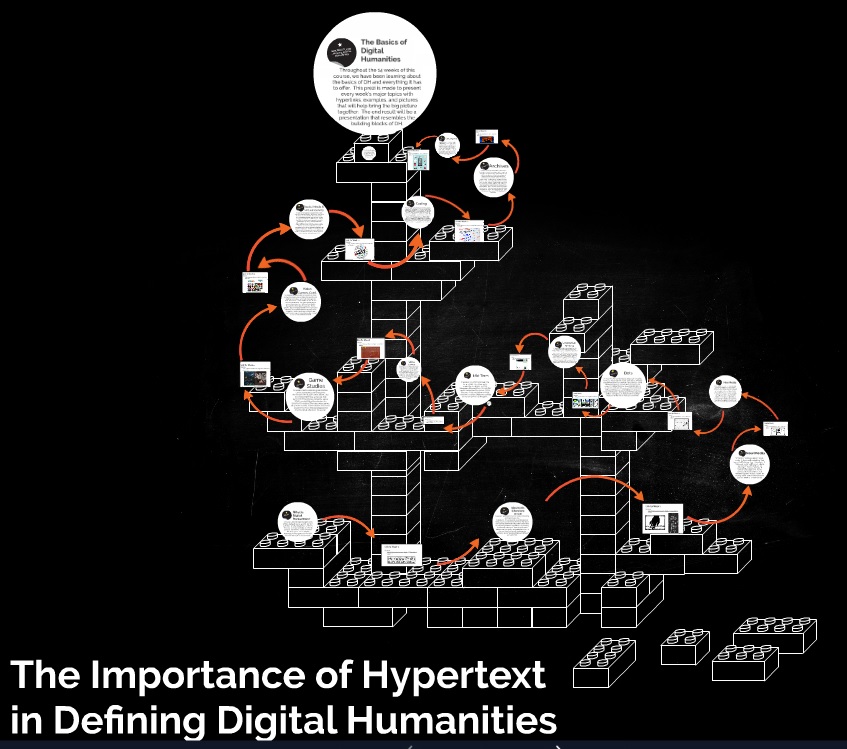
With Bailyn's building blocks of Digital Humanities, she outlined the entire course from start to finish. While it not only reviewed the topics we discussed in class, it also served as a reminder for how much we really did this semester and how much we really learned. She started from the very beginning, and worked up until the very end of the class, following the class schedule and assigned readings. While she mainly focused on hyperlinks, the prezi was able to show so much more than them. It was nice to see all of the work that was put in to the entire year, all wrapped up in a single presentation.
Morgan's presentation of the technology of how doctor's can see the body was a very eye-opening experience. It showed how with increasing technology, doctors can now operate and direct surgeries without even looking at their patient. They are accurate enough to reproduce the images of
the body and present them as a sort of hologram. While scans and x-rays can produce images of the body now, they are only 2-D images. With this new technology, bodies are now able to be presented in a 3-D atmosphere, with all of the defects included.
With Bailyn's building blocks of Digital Humanities, she outlined the entire course from start to finish. While it not only reviewed the topics we discussed in class, it also served as a reminder for how much we really did this semester and how much we really learned. She started from the very beginning, and worked up until the very end of the class, following the class schedule and assigned readings. While she mainly focused on hyperlinks, the prezi was able to show so much more than them. It was nice to see all of the work that was put in to the entire year, all wrapped up in a single presentation.
Morgan's presentation of the technology of how doctor's can see the body was a very eye-opening experience. It showed how with increasing technology, doctors can now operate and direct surgeries without even looking at their patient. They are accurate enough to reproduce the images of
the body and present them as a sort of hologram. While scans and x-rays can produce images of the body now, they are only 2-D images. With this new technology, bodies are now able to be presented in a 3-D atmosphere, with all of the defects included.
Social Media's Effects on its Users
The final project for digital humanities consisted of a brief presentation that summarized what I wanted to write about. For this part of the project, I created a Prezi because of its user-friendly and interactive nature. My project is essentially about social media and how it affects its users.
Every day, millions of people use outlets such as Facebook, Twitter, and Instagram. Different demographics are a part of this, but I really tried to focus on comparing and contrasting younger people with older age groups to show the differences in effects.
Older demographics are drawn more towards Facebook because it is so user-friendly, and because of this, the younger demographic on Twitter and Instagram is much larger. Twitter, an immediate news-sharing website, and Instagram, a photo and video-sharing website, draw in younger groups because of their instantaneous media sharing. Here is a link to my project.
-Alex
Every day, millions of people use outlets such as Facebook, Twitter, and Instagram. Different demographics are a part of this, but I really tried to focus on comparing and contrasting younger people with older age groups to show the differences in effects.
Older demographics are drawn more towards Facebook because it is so user-friendly, and because of this, the younger demographic on Twitter and Instagram is much larger. Twitter, an immediate news-sharing website, and Instagram, a photo and video-sharing website, draw in younger groups because of their instantaneous media sharing. Here is a link to my project.
-Alex
Bailyn's Final
My final paper is about how important hyperlinks are for this class and everyday life. Throughout the paper, the history, examples, and future of hyperlinks will be addressed. Hyperlinks are something that we used a lot in this class, and they stood out as a very important aspect to take away from this c
lass. My original work of electronic literature relates to the importance of hyperlinks by presenting the 14 weeks with their hyperlinks and materials from the course. The 14 weeks are represented as the building blocks of digital humanities. As one explores the Prezi, they will gain a recap of the important topics of this class, and an analysis of what I took away from each week. After creating and displaying my multimedia component in class, I walked around to view the work of my classmates.
During the last couple days of Digital Humanities, we spent the time in class collaborating our ideas and viewing each other's multimedia components. All of the pieces that I looked at were very interesting. However, the two that I was most interested in were actually two of my tribe members. The first one related to a bot, and it showed how bots are becoming more present in today's society.
The example on the Prezi was how bots can be used to automatically fill in important information from emergency responder calls. The bots will act as documentation assistance for the busy first responders who put their lives on the line each and every day. The second multimedia component that I viewed focused on sampling and repurposing. They took multiple different parts of a jazz songs and merged them together to create a whole new work of art. In class we talked about this and the question of who owns the new work?? I was confused about this question until I saw it first hand, and now it is clear that the new author is the one who should be given ownership of work. The individual told me about all of the time and effort they put into working on this piece, and after hearing the original piece versus the second, you cold tell it was a completely different song. This is actually something we hear everyday on the radio. Artists are always taking sections of other songs and working it into their own work, and it wasn't until this class that I got to see the repurposing being done first hand.
Wednesday, December 14, 2016
Final Project Exhibit
In preparation for the final project in digital humanities, the class viewed each others' final project ideas in attempt to peer-review and receive feedback before the final due date of the essay. During this exhibit, members of the class walked around as owners of the project presented a brief description of their projects on computers as the viewers critiqued the projects.
I presented via use of a Prezi, making sure to just skim over the most important points of my essay. The projects that I was able to view were similar in presentation; Prezi was used frequently because of its user-friendly layout and interactive components.
One essay presentation focused on the merging of social media and politics as well as younger generations' use of social media and its impact on their political awareness. Within this essay, the influence of Twitter bots, the sharing of articles, and the influence news sources have on social media users.
Similarly, another project I viewed was all about bots and whether or not meaning can be made from the material they produce. The bots that were included in this presentation primarily consisted of Twitter bots. The final project I viewed was about hypertext media. Within this project, the author was creating a project about the importance of hyperlinks and their history as well as their influence on digital culture.
I presented via use of a Prezi, making sure to just skim over the most important points of my essay. The projects that I was able to view were similar in presentation; Prezi was used frequently because of its user-friendly layout and interactive components.One essay presentation focused on the merging of social media and politics as well as younger generations' use of social media and its impact on their political awareness. Within this essay, the influence of Twitter bots, the sharing of articles, and the influence news sources have on social media users.
Similarly, another project I viewed was all about bots and whether or not meaning can be made from the material they produce. The bots that were included in this presentation primarily consisted of Twitter bots. The final project I viewed was about hypertext media. Within this project, the author was creating a project about the importance of hyperlinks and their history as well as their influence on digital culture.
Friday, December 9, 2016
The Swiss Army Knife of the Digital World
As humans and society evolves, technology follows in tow. With the progression of technology, producers are creating products that are multi-functional yet incapable of performing all tasks that are desired or required by their consumers. We are not incapable of producing technology that cannot perform, or converge, all of our tasks; the companies that create these products make them in such a way that renders society dependent on needing more, thus buying more.
Convergence, in Layman's terms, is when different forms of media, or mediums, come together into one singular medium. Henry Jenkins explains convergence in his article "Convergence Culture" without necessarily defining convergence; Jenkins offers multiple examples of convergence within modern culture, allowing his readers to better understand the idea more personally. In his article, Jenkins discusses his coined term "black box," or the all-encompassing term for technology that is literally a black box-- the TV, DVD player, gaming systems, or technology of the sort. These black boxes are being converged, or combined, into simpler devices to make life more efficient and less cluttered for its users. It is theorized, however, that there will not be one singular black box to perform all tasks.
"We can see the proliferation of black boxes as symptomatic of a moment of convergence: because no one is sure what kinds of functions should be combined, we are forced to buy a range of specialized and compatible devices," this is directly from Jenkins's article in his discussion about his idea of the black box. Furthermore, if a company such as Apple created a singular black box, it would eliminate the necessity for other products or even other technology companies. Until then, however, we are left with all of our unnecessary black boxes left to converge over other various media such as, the television, Internet, and any form of technology that requires advancement.
"We can see the proliferation of black boxes as symptomatic of a moment of convergence: because no one is sure what kinds of functions should be combined, we are forced to buy a range of specialized and compatible devices," this is directly from Jenkins's article in his discussion about his idea of the black box. Furthermore, if a company such as Apple created a singular black box, it would eliminate the necessity for other products or even other technology companies. Until then, however, we are left with all of our unnecessary black boxes left to converge over other various media such as, the television, Internet, and any form of technology that requires advancement. Monday, November 21, 2016
Always Growing and Always Learning
My latest endeavor in the world of the digital humanities was confusing but also really fun after I got started. This is an original work of electronic literature, and more specifically,it is a hypertext narrative. I hope you are able to follow the narrative and can get something from my sort of story/sort of insight on growing.
-Alex
Original E-Lit
Hey guys,
Feel free to take a look at my original work of E-lit, "The Job You Hate to Love." It's about some significant moments during the journey of my career in the fire service to date. It starts at my first day and highlights some events chronologically, with the last event being less than a week old.
View it here.
Feel free to take a look at my original work of E-lit, "The Job You Hate to Love." It's about some significant moments during the journey of my career in the fire service to date. It starts at my first day and highlights some events chronologically, with the last event being less than a week old.
View it here.
Dreams of Death: King Heroin
Hey, Guys! Please check out my original Google Maps Essay called "Dreams of Death: King Heroin". It is about a dream I once had based off of a Heroin Epidemic back home in Harrisburg, PA.
Thank You!
Click here for Dreams of Death: King Heroin
Thank You!
Click here for Dreams of Death: King Heroin
Archiving Drugs
For centuries, people all over the world have chased an
alternate dimension, or a different state of mental capabilities through the access of drugs. They seek another state of mind and personality to explore, no matter
how detrimental to their health or well-being. Not to mention, illegal possessions which have greater repercussions. Essentially, only one
thing has changed over all of these years, and that is the method of how drugs are prepared and used.Something that would be eye-opening and most likely beneficial to society is to have an archive of some of the different paraphernalia used with the drugs. It would be a great way to see not only all of the differences but also some of the similarities from the early days of drug usage to today. Some of the archaic instruments that they may have used in the early 18th century may not even be around nowadays for people to view.
Think of it as almost the same deal as a car: in the beginning, everything was very primitive-- there was nothing fancy about anything, it was made to simply do one job and one job only. The
same can be said about drug paraphernalia. It was
most likely made to be used with drugs, and throughout the years, it has been modified
to look like an everyday object because of the degree of police coverage and experience with drugs. Especially with the epidemic that our country is facing
these days, it would be able to help people identify possible dangerous
situations and maybe even help them save someone’s life.The way to go about creating a drug archive would be to first obtain a domain name on the internet. From there, find some of the older paraphernalia dating back to the 18th century and photograph it, making the pictures appear chronologically. It could start with the original devices and show the modifications made throughout the centuries and decades leading up to present day items used in drug abuse. Not only would it open up knowledge to the types of use, but it could also serve as a reminder that it is a very real situation that occurs more than most people think. This archive would be beneficial to everyone, but most importantly to the future of our children and the safety of our country.
December Weekend in NYC
Friday, November 18, 2016
Data Mining Our Blogs
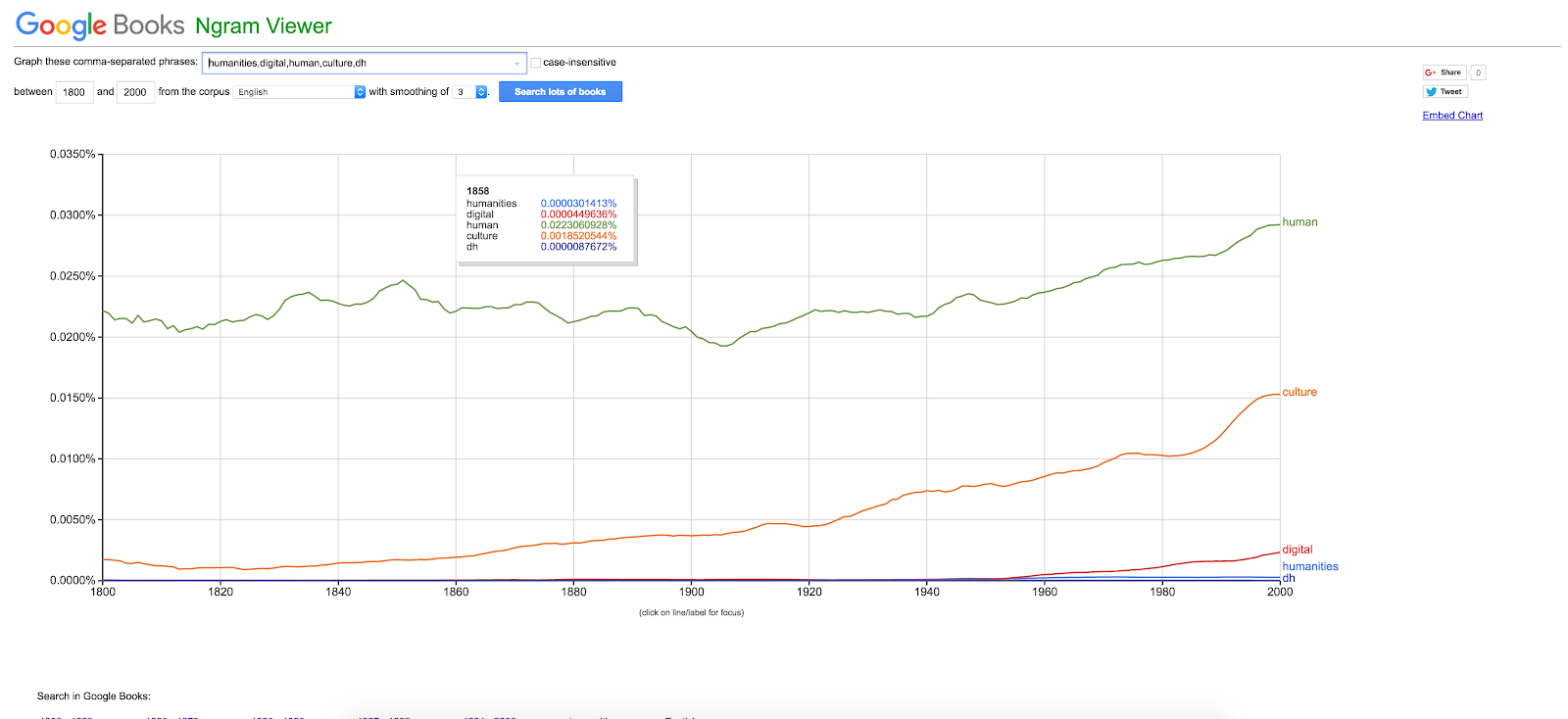
Based off of what we found from the results on Voyant, the Ngram tool has provided us with some insight on how some of the most popular terms have been used and have correlated historically. According to Ngram, the terms humanities and DH have peaked very little, if not at all. With DH being very situation dependent, there is no surprise there. there is only some activity on it around 1980. Human and culture, on the other hand, have shared a bit of popularity over the years. They both experienced a spike in use around the 1960's, which is around the hippy movement, when everyone really started to focus on the human movement. As humanity started to progress into the 2000's, both of the words have risen simultaneously, sharing almost the same slope for both of them.
Monday, November 14, 2016
My Relevance in Social Media
Life is tough as a young adult placed in a social setting; further worsening the situation, digitize said social setting and you have a world made up of multiple social media platforms where people from all over the world can interact. As a young adult and a user of five different social media platforms, I can say with full confidence that the "self" I portray on each website is different but also similar in some ways.
A contrasting example of this idea is my personal Twitter account. Although two completely different platforms of social media, my Twitter account contrasts with Kim Kardashian's Instagram. My tweets are more honest and tend to be stream of consciousness that fit within a certain sarcastic narrative. In person I am quiet and I don't share my opinions unless I feel comfortable to do so. On Twitter, I share my opinions freely with my followers as well as anything that is relevant to social media culture. This starkly contrasts with Kim K's use of her social media because she filters what her followers take in while I tweet statements that directly reflect my thoughts.
In the article "The Self in Selfie: Identity in the Age of Social Media," the author explains how social media users portray themselves differently than they do in real life. Take a celebrity, Kim Kardashian, as an example and look at how she portrays her life on Instagram-- in every photo, everyone is always posed perfectly, their skin is always smooth with no stretch or wrinkle, and even when she is "bare-faced," she still looks perfect.
A contrasting example of this idea is my personal Twitter account. Although two completely different platforms of social media, my Twitter account contrasts with Kim Kardashian's Instagram. My tweets are more honest and tend to be stream of consciousness that fit within a certain sarcastic narrative. In person I am quiet and I don't share my opinions unless I feel comfortable to do so. On Twitter, I share my opinions freely with my followers as well as anything that is relevant to social media culture. This starkly contrasts with Kim K's use of her social media because she filters what her followers take in while I tweet statements that directly reflect my thoughts. Sunday, November 13, 2016
Tim Virtual Identity
I
feel as though my virtual reality mirrors my actual self fairly well. I like to
think that I'm a fairly straight forward person, and content enough with who I
am to share with others. Some people, I have noticed, try to bolster their
appearance on social media to maybe make themselves seem more impressive. The
question I always ask is who are you trying to impress? My pages are me. The
sarcasm that I share on my pages and the sick and sometimes sadistic humor that
make an appearance on my page are the same things that I enjoy in real life. Of
course, I use the term "enjoy" very loosely. Personally, I use
social media for a form of entertainment. When I log into Facebook or
Instagram, I like to look a posts and pages that make me feel happy, or leave
me laughing. With that, I like to try and instill the same feeling amongst
those that may be viewing my page or seeing what I post. I don’t want to be
characterized as one of those people that are always complaining about every
minute detail about their life to their Facebook friends instead of hitting the
problem head-on to mitigate it. In the same token, with today’s electronic
society, the last thing that I want is for a future employer to look at my
page(s) and see nothing but vulgarity and negativity. If I were an employer and
see nothing but complaining and whining on someone’s page, that screams to me
that the person is not proactive. They would rather sit back and ride the wave,
rather than swim through it and fight the resistance. With that being said, if
my personal page is nothing but unprofessional, what will that look like to
someone that is looking in to hiring me as a part of their company? They say
that first impressions can mean the world. What more is social media than one
giant first impression? Wouldn’t you want it to be the best that it possibly
can?Wednesday, November 9, 2016
Bailyn's Virtual Identity
What is a Virtual Identity?
A virtual
identity is a profile that an individual makes on social medias such as
Facebook, Instagram, or even videogames.
Those who create the accounts are completely free to manage the account
however they please, selectively choosing what information other viewers get to
see. According to CNN.com,
“In a virtual world, online identity is potentially much more flexible than
real identity, allowing easily changes in race, class, gender, age,
socio-economic background, and even species.”
Virtual identities are sometimes an escape for people, where there are
able to perceive their lives differently than the real world. Actually- as I am writing this blog I keep
singing Brad Paisley’s song, Online…it is directly
related to this topic! Not all online
profiles fake information to make an individual look more impressive, they can
also show more personal information to the public that isn’t necessarily
known. Take LinkedIn for instance, it
allows professionals to talk about their business success, certificates
received, and to connect with potential employers near and far. For this type of account, it is crucial for
the account information to be correct and up to date. In all aspects, virtual identity offers more
for others to see than a driver’s license, or personal image in the real world.
My Virtual Identity
With the internet becoming more modern, it is common for
everyone to have online accounts. I have
accounts on Ingram, Facebook, Pinterest, etc.
I feel like my virtual identity is very true to who I am in real life as
well. I don’t have any fake accounts, I
don’t post stuff that I don’t believe in, and I am constantly updating
information as it becomes known. We talked
as a class about whether or not we actually exist in a virtual reality, or if
it is just our conscious. I believe that
a little bit of everyone’s conscious resides in every online account they
create. When we are making those
profiles as a snapshot into our lives, we are very tedious, accurate, and judgmental
of ourselves. We want to look perfect
in the eyes of others, therefore we are always worried about what they are
seeing, thinking, and reading. The days
of technology advancing, our conscious is only going to become more submerged
in online identities as the years go on.
Is Human Intelligence Natural?
I believe that Human Intelligence is natural, and that we
were placed on this earth in order to learn and develop our brains and
knowledge over time. It all starts in
pre-school where we learn the basics and it gets harder over time as we seek
higher education and challenging degrees.
We all have different abilities which shape the way in which we learn,
but in one way or another, every person on this earth is learning something or
demonstrating something they have learned, every single day. There are some instances where natural human
intelligence needs to be controlled, just to maintain appropriateness for
example. There is a quote I read online
that is perfect for this paragraph, because it explains how human intelligence
is natural, endless, and enhancing our future.
“Human Intelligence and ingenuity have consistently and repeatedly
unlocked technological and scientific advances that have raised the standard of
living each generation compared to its predecessor, while increasing the
ability of human society to support larger numbers of people and increasing the
carrying capacity of the planet.” This
quote ties us into the next section, about natural intelligence in terms of
technology, where it is argued that intelligence in terms of technology is not
natural, but instead programmed.
Is Technology Intelligence Natural?
I do not believe that computer intelligence is natural. Just because technology is able to respond to
us when we ask certain questions or select certain buttons, it was not able to
do that without prior help. I argue this
opinion because somewhere, behind the scenes, there is someone who had to
program the technology to be capable for responding intelligently. A computer by itself is not smart, and has no
prior knowledge of its own. Take Siri
for instance, if you do not ask her questions in a specific sequence, she is
not helpful at all. Siri would probably
be able to pass the Turing test, but it is not something thought of to have
natural intelligence. Think about it,
Siri is programmed in English, so what happens if you want to use a different language…will
it work?? On the supporting side, some
argue that because our suggestions on Facebook for ‘people you may know’ are
90% correct that we know that person, it does classify as natural
intelligence. Wrong. Facebook is able to recommend stuff to us,
based on a program that gives feedback based on the links you click on. We, the users, and giving the programmers
information that they are relaying back to us through the computer
software.
Wednesday, October 26, 2016
Subscribe to:
Posts (Atom)